
How to prevent AI hallucinations in customer support
Why support AI makes things up, how grounded answers with cited sources prevent it, and what to check before you trust an AI tool with customer questions.
Product page: Knowledge and citations

A customer asks your AI assistant whether they can return an opened item. It replies, confidently, that yes, opened items get a full refund within 30 days. Your actual policy says store credit within 14 days. Now your team has to walk it back, the customer feels misled, and everyone quietly starts wondering what else the bot got wrong.
One confident, wrong answer does more damage than a dozen slow ones. The fix is not a cleverer AI. It is an AI that answers only from your material and shows where each answer came from.
Why do AI chatbots hallucinate in customer support?
Large language models are very good at fluent, plausible text. Left to their own knowledge, they will happily describe a "typical" returns policy that has nothing to do with yours. This is often called hallucination, but in support it is usually simpler: the assistant was asked something it had no facts for, and it filled the gap.
There are three usual culprits:
- No source at all. The assistant answers from general knowledge.
- A stale source. An old PDF still describes last year's policy.
- Conflicting sources. Two documents disagree and the assistant picks one.
Citations help with all three, because they make the source visible.
What does a grounded answer look like?
A grounded assistant follows one rule: find the relevant passages in the business's own sources, then answer only from them.
 Fernwood HomeWeb chat · example conversation
Handed to the team · No source found
The second answer matters as much as the first. An AI agent that says when it does not know is worth more than one that always has an answer. "I can't find that, let me get someone" is exactly what you want when the information is not there.
Why do citations make such a difference?
That small "Source:" line does a lot of work:
- Customers trust the answer more when they can see it comes from the actual policy.
- Your team can verify in seconds instead of hunting for the right document.
- Mistakes become fixable. If an answer is wrong, the citation points straight at the document to update.
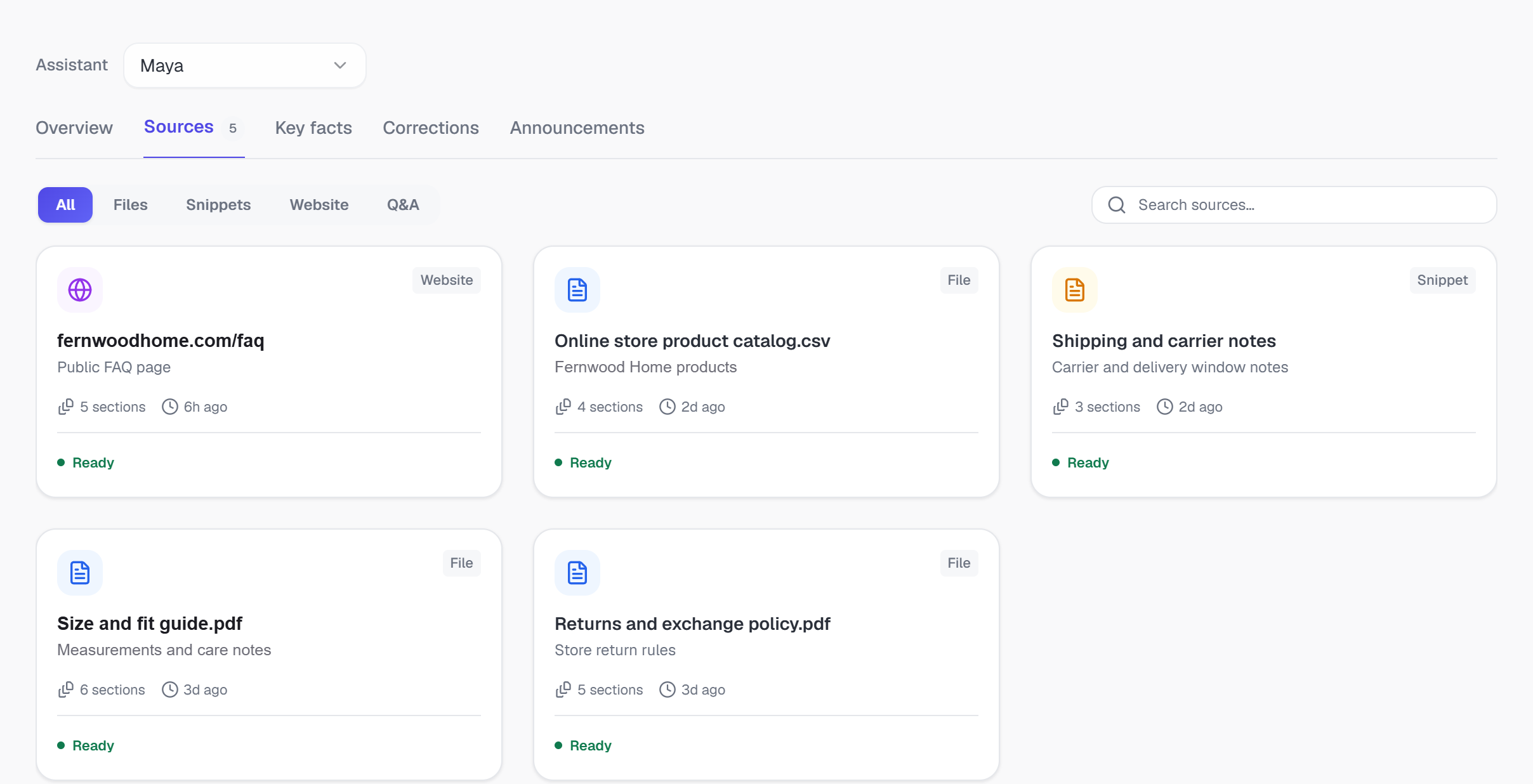
How does grounding change maintenance?
With a scripted bot, changing a policy means hunting down every reply that mentions it. With a grounded assistant, you update the source document and every future answer follows it. Your knowledge base becomes the single place where the truth lives, which is why it pays to train the chatbot on your website and documents instead of writing replies by hand.
That only works if the sources are kept in order:
- Archive what is out of dateOld PDFs and retired pages are the most common cause of wrong answers.
- Decide which source winsFor example, "the website is always more current than PDFs".
- Update on every changeWhen a price, policy or opening time changes, change the source the same day.
- Review flagged answers weeklyHandoffs the AI could not answer show you where sources are missing.
What should you ask a vendor about hallucinations?
When you evaluate AI customer support software, ask:
- Can answers be restricted to my own sources? This should be the default, not an option.
- Does every factual answer show a source? At least for policies, prices and availability.
- What happens when no source is found? It should say so and hand over.
- Can I see which source was used in past conversations? Invaluable when reviewing a complaint.
- How do I update the knowledge? Replacing a document should be enough.
The bottom line
Customers do not need an AI that knows everything. They need one that knows your business and is honest about the limits of what it knows. Grounding and citations are how you get there, and they turn an AI assistant from a liability into something your team can rely on. For a broader comparison of approaches, see AI customer support vs. a chatbot.
Frequently asked questions
What is a grounded AI answer?
An answer the AI built only from passages it found in the business's own sources, such as its website, policies and catalog, rather than from general knowledge.
How do citations reduce wrong answers?
They make the source visible. Customers and staff can check an answer, and when an answer is wrong the citation shows exactly which document needs fixing.
What should an AI do when it cannot find an answer?
Say it does not know and hand the conversation to a person. A confident guess is the most damaging thing a support AI can do.
What happened in the Air Canada chatbot case?
In 2024, a Canadian tribunal held Air Canada responsible after its website chatbot told a passenger they could apply for a bereavement fare after travel, which contradicted the airline's actual policy. The ruling made the point plainly: a business answers for what its chatbot tells customers.
Can AI hallucinations be eliminated completely?
Not entirely, but the risk falls a lot when the AI may only answer from your sources, can show the source, and hands over when nothing matches. Reviewing handed-over questions each week shows where sources are missing.